Q \mathbb{Q} Q 基本代数定理 FTA:任何大于1的整数都能被分解为质数乘积 n = p 1 e 1 ⋯ p r e r n=p_1^{e_1}\cdots p_r^{e_r} n = p 1 e 1 ⋯ p r e r
良序公理:非空非负子集有最小元
带余除法:a = b q + r a=bq+r a = b q + r
理想:加法/数乘封闭,d Z = { 0 , ± d , ± 2 d , ⋯ } d\mathbb{Z}=\{0,\pm d,\pm 2d,\cdots\} d Z = { 0 , ± d , ± 2 d , ⋯ } a Z + b Z = gcd ( a , b ) Z a\mathbb{Z}+b\mathbb{Z}=\gcd(a,b)\mathbb{Z} a Z + b Z = g cd( a , b ) Z
gcd ( a , b ) = p 1 m i n ( { α 1 , β 1 } ) ⋯ p r m i n ( { α r , β r } ) \gcd(a,b)=p_1^{min(\{\alpha_1,\beta_1\})}\cdots p_r^{min(\{\alpha_r,\beta_r\})} g cd( a , b ) = p 1 m i n ( { α 1 , β 1 } ) ⋯ p r m i n ( { α r , β r } ) 裴蜀定理 Bézout’s Theorem:∃ s , t ∈ Z , gcd ( a , b ) = a s + b t \exists s,t\in\mathbb{Z},\gcd(a,b)=as+bt ∃ s , t ∈ Z , g cd( a , b ) = a s + b t
二元关系:是 A × B A\times B A × B R R R a R b aRb a R b ( a , b ) ∈ R (a,b)\in R ( a , b ) ∈ R
等价关系:R R R A A A ∀ a ∈ A , a R a \forall a\in A,aRa ∀ a ∈ A , a R a
等价类:[ a ] R = { b ∈ A : a R b } , a ∈ A [a]_R=\{b\in A:aRb\},a\in A [ a ] R = { b ∈ A : a R b } , a ∈ A
剩余类:[ a ] n = a + n Z = { a + n x : x ∈ Z } [a]_n=a+n\mathbb{Z}=\{a+nx:x\in Z\} [ a ] n = a + n Z = { a + n x : x ∈ Z } a m o d n a\bmod n a m o d n
Z n = { [ 0 ] n , [ 1 ] n , ⋯ , [ n − 1 ] n } = { 0 , 1 , ⋯ , n − 1 } \mathbb{Z}_n=\{[0]_n,[1]_n,\cdots,[n-1]_n\}=\{0,1,\cdots,n-1\} Z n = { [ 0 ] n , [ 1 ] n , ⋯ , [ n − 1 ] n } = { 0 , 1 , ⋯ , n − 1 }
[ b ] n [ s ] n = [ 1 ] n [b]_n[s]_n=[1]_n [ b ] n [ s ] n = [ 1 ] n [ s ] n [s]_n [ s ] n [ b ] n [b]_n [ b ] n Z n ∗ = { [ b ] n ∈ Z n : gcd ( b , n ) = 1 } \mathbb{Z}_n^*=\{[b]_n\in\mathbb{Z}_n:\gcd(b,n)=1\} Z n ∗ = { [ b ] n ∈ Z n : g cd( b , n ) = 1 } n n n 欧拉 ϕ \phi ϕ ϕ ( n ) = ∣ Z n ∗ ∣ = n ( 1 − p 1 − 1 ) ⋯ ( 1 − p r − 1 ) \phi(n)=|\mathbb{Z}_n^*|=n(1-p_1^{-1})\cdots(1-p_r^{-1}) ϕ ( n ) = ∣ Z n ∗ ∣ = n ( 1 − p 1 − 1 ) ⋯ ( 1 − p r − 1 )
欧拉定理:n ≤ 1 , α ∈ Z n ∗ n \le 1, \alpha \in \mathbb{Z}_n^* n ≤ 1 , α ∈ Z n ∗ α ϕ ( n ) = 1 \alpha^{\phi(n)}=1 α ϕ ( n ) = 1
费马小定理:在欧拉定理基础上取 n n n α p − 1 = 1 \alpha^{p-1}=1 α p − 1 = 1
RSA:取质数 p , q , N = p q , r = ϕ ( N ) p,q,N=pq,r=\phi(N) p , q , N = p q , r = ϕ ( N ) e , e < r , gcd ( e , r ) = 1 e,e<r,\gcd(e,r)=1 e , e < r , g cd( e , r ) = 1 d = e − 1 m o d r d=e^{-1}\bmod r d = e − 1 m o d r
公钥 ( N , e ) (N,e) ( N , e ) ( N , d ) (N,d) ( N , d ) m → c : = m e m o d N → m = c e m o d N m\rightarrow c:=m^e\bmod N\rightarrow m=c^e\bmod N m → c : = m e m o d N → m = c e m o d N
二进制加减法:O ( k ) O(k) O ( k ) O ( k 2 ) O(k^2) O ( k 2 ) O ( ( k − l + 1 ) ⋅ l ) O((k-l+1)\cdot l) O ( ( k − l + 1 ) ⋅ l ) O ( k ) O(k) O ( k )
乘法:和快速幂同一种算法;除法:先令余数 r : = a r:=a r : = a
扩展欧几里得算法(EEA):求解 a s + b t = gcd ( a , b ) as+bt=\gcd(a,b) a s + b t = g cd( a , b ) r 0 = a , r 1 = b r_0=a,r_1=b r 0 = a , r 1 = b O ( l ( a ) l ( b ) ) O(l(a)l(b)) O ( l ( a ) l ( b ) )
i r i q i s i t i 0 12345 1 0 1 123 100 0 1 2 45 2 1 − 100 3 33 1 − 2 201 4 12 2 3 − 301 5 9 1 − 8 803 6 3 3 11 − 1104 7 0 \begin{array}{|c|c|c|c|c|}
\hline
i & r_i & q_i & s_i & t_i \\
\hline
0 & 12345 & & 1 & 0 \\
1 & 123 & 100 & 0 & 1 \\
2 & 45 & 2 & 1 & -100 \\
3 & 33 & 1 & -2 & 201 \\
4 & 12 & 2 & 3 & -301 \\
5 & 9 & 1 & -8 & 803 \\
6 & 3 & 3 & 11 & -1104 \\
7 & 0 & & & \\
\hline
\end{array}
i 0 1 2 3 4 5 6 7 r i 1 2 3 4 5 1 2 3 4 5 3 3 1 2 9 3 0 q i 1 0 0 2 1 2 1 3 s i 1 0 1 − 2 3 − 8 1 1 t i 0 1 − 1 0 0 2 0 1 − 3 0 1 8 0 3 − 1 1 0 4
(疑似不重要)素数理论:π ( x ) \pi(x) π ( x ) x x x lim x → ∞ π ( x ) x ln x = 1 \lim_{x\to\infty}\frac{\pi(x)}{\frac{x}{\ln x}}=1 lim x → ∞ l n x x π ( x ) = 1 P n \mathbb{P}_n P n 2 n − 1 2^{n-1} 2 n − 1 2 n 2^n 2 n ∣ P n ∣ ≥ 2 n n ln 2 ( 1 2 + O ( 1 n ) ) |\mathbb{P}_n|\ge \frac{2^n}{n\ln2}(\frac{1}{2}+O(\frac{1}{n})) ∣ P n ∣ ≥ n l n 2 2 n ( 2 1 + O ( n 1 ) )
线性同余方程:d : = gcd ( a , n ) , a x ≡ b ( m o d n ) d:=\gcd(a,n),ax\equiv b\pmod n d : = g cd( a , n ) , a x ≡ b ( m o d n ) ⇔ d ∣ b \Leftrightarrow d\mid b ⇔ d ∣ b b = k gcd ( a , n ) b=k\gcd(a,n) b = k g cd( a , n )
d : = gcd ( a , n ) , t : = ( a d ) − 1 m o d n d , d ∣ b d:=\gcd(a,n),t:=(\frac{a}{d})^{-1} \bmod \frac{n}{d},d \mid b d : = g cd( a , n ) , t : = ( d a ) − 1 m o d d n , d ∣ b a x ≡ b ( m o d n ) ⇔ x ≡ b d t ( m o d n d ) ax\equiv b\pmod n \Leftrightarrow x \equiv \frac{b}{d}t \pmod {\frac{n}{d}} a x ≡ b ( m o d n ) ⇔ x ≡ d b t ( m o d d n ) 中国剩余定理:{ x ≡ b i ( m o d n i ) \{x \equiv b_i \pmod{n_i} { x ≡ b i ( m o d n i ) n i n_i n i
先求 n = ∏ n i n=\prod n_i n = ∏ n i N i = n n i N_i=\frac{n}{n_i} N i = n i n s i N i + t i n i = 1 s_iN_i+t_in_i=1 s i N i + t i n i = 1 s i s_i s i b = ∑ b i ( N i s i ) b=\sum b_i(N_is_i) b = ∑ b i ( N i s i ) [ b ] n [b]_n [ b ] n
CRT 映射:k k k n = ∏ n i n=\prod n_i n = ∏ n i θ ( [ x ] n ) = ( [ x ] n 1 , ⋯ , [ x ] n k ) \theta([x]_n)=([x]_{n_1},\cdots,[x]_{n_k}) θ ( [ x ] n ) = ( [ x ] n 1 , ⋯ , [ x ] n k ) Z n \mathbb{Z}_n Z n Z n 1 × ⋯ × Z n k \mathbb{Z}_{n_1}\times\cdots\times\mathbb{Z}_{n_k} Z n 1 × ⋯ × Z n k Z n ∗ \mathbb{Z}_n^* Z n ∗ Z n 1 ∗ × ⋯ × Z n k ∗ \mathbb{Z}_{n_1}^*\times\cdots\times\mathbb{Z}_{n_k}^* Z n 1 ∗ × ⋯ × Z n k ∗
良定义:[ x ] n = [ y ] n ⇒ θ ( [ x ] n ) = θ ( [ y ] n ) [x]_n=[y]_n\Rightarrow\theta([x]_n)=\theta([y]_n) [ x ] n = [ y ] n ⇒ θ ( [ x ] n ) = θ ( [ y ] n ) θ ( [ x ] n ) = θ ( [ y ] n ) ⇒ [ x ] n = [ y ] n \theta([x]_n)=\theta([y]_n)\Rightarrow[x]_n=[y]_n θ ( [ x ] n ) = θ ( [ y ] n ) ⇒ [ x ] n = [ y ] n
欧拉 ϕ \phi ϕ n = n 1 ⋯ n k n=n_1\cdots n_k n = n 1 ⋯ n k n i n_i n i ϕ ( n ) = ϕ ( n 1 ) ⋯ ϕ ( n k ) \phi(n)=\phi(n_1)\cdots\phi(n_k) ϕ ( n ) = ϕ ( n 1 ) ⋯ ϕ ( n k ) n i n_i n i ϕ ( n ) = ( p 1 e 1 − p 1 e 1 − 1 ) ⋯ ( p k e k − p k e k − 1 ) = n ( 1 − p 1 − 1 ) ⋯ ( 1 − p k − 1 ) \phi(n)=(p_1^{e_1}-p_1^{e_1-1})\cdots(p_k^{e_k}-p_k^{e_k-1})=n(1-p_1^{-1})\cdots(1-p_k^{-1}) ϕ ( n ) = ( p 1 e 1 − p 1 e 1 − 1 ) ⋯ ( p k e k − p k e k − 1 ) = n ( 1 − p 1 − 1 ) ⋯ ( 1 − p k − 1 )
群:封闭性 Closure、结合律 Associative、单位元 Identity (a ∗ e = e ∗ a = a a*e=e*a=a a ∗ e = e ∗ a = a a ∗ b = b ∗ a = e a*b=b*a=e a ∗ b = b ∗ a = e
( Z n , + ) (\mathbb{Z}_n,+) ( Z n , + ) [ 0 ] n [0]_n [ 0 ] n ( Z n ∗ , ⋅ ) (Z_n^*,\cdot) ( Z n ∗ , ⋅ ) n > 1 n>1 n > 1 阶 Order:群的阶是群的元素个数;群内元素 a a a a l = 1 a^l=1 a l = 1 l l l l a = 0 la=0 l a = 0
若乘法阿贝尔群阶数为 m m m a ∈ G a\in G a ∈ G a m = 1 a^m=1 a m = 1
子群:( G , ⋅ ) (G,\cdot) ( G , ⋅ ) g ∈ G , ⟨ g ⟩ = { g k : k ∈ Z } g\in G,\langle g \rangle = \{g^k:k\in\mathbb{Z}\} g ∈ G , ⟨ g ⟩ = { g k : k ∈ Z } G G G ⟨ g ⟩ ≤ G \langle g \rangle \le G ⟨ g ⟩ ≤ G
循环群 Cyclic Group:⟨ g ⟩ = G \langle g \rangle = G ⟨ g ⟩ = G g g g G G G p p p Z p ∗ \mathbb{Z}_p^* Z p ∗
DLOG:循环群内若 h = g x h=g^x h = g x x = log g h x=\log_g h x = log g h x x x h h h
若安全素数 p = 2 q + 1 p=2q+1 p = 2 q + 1 q q q exp ( O ( ln q ln ln q ) ) \exp(O(\sqrt{\ln q\ln\ln q})) exp ( O ( ln q ln ln q ) )
Diffie-Hellman Key Exchange:A, B 规定大素数 p p p g g g G = ⟨ g ⟩ G=\langle g \rangle G = ⟨ g ⟩ p p p a ← Z p , A = g a a\leftarrow \mathbb{Z}_p,A=g^a a ← Z p , A = g a b ← Z p , B = g b b\leftarrow\mathbb{Z}_p,B=g^b b ← Z p , B = g b k = B a = A b = g a b k=B^a=A^b=g^{ab} k = B a = A b = g a b
集合的基数 Cardinality:若是有限集,则为元素个数
两个任意集合 A , B A,B A , B ∣ A ∣ = ∣ B ∣ |A|=|B| ∣ A ∣ = ∣ B ∣ f : A → B f:A\rightarrow B f : A → B
当存在单射 f : A → B f:A\rightarrow B f : A → B ∣ A ∣ ≤ ∣ B ∣ |A|\le|B| ∣ A ∣ ≤ ∣ B ∣ ∣ A ∣ ≠ ∣ B ∣ |A|\ne|B| ∣ A ∣ = ∣ B ∣ ∣ A ∣ < ∣ B ∣ |A|<|B| ∣ A ∣ < ∣ B ∣
∣ Z + ∣ = ∣ N ∣ = ∣ Q + ∣ = ∣ Q ∣ , ∣ R + ∣ = ∣ R ∣ = ∣ ( 0 , 1 ) ∣ = ∣ [ 0 , 1 ] ∣ |\mathbb{Z}^+|=|\mathbb{N}|=|\mathbb{Q}^+|=|\mathbb{Q}|,|\mathbb{R}^+|=|\mathbb{R}|=|(0,1)|=|[0,1]| ∣ Z + ∣ = ∣ N ∣ = ∣ Q + ∣ = ∣ Q ∣ , ∣ R + ∣ = ∣ R ∣ = ∣ ( 0 , 1 ) ∣ = ∣ [ 0 , 1 ] ∣ 证明 ∣ ( 0 , 1 ) ∣ = ∣ [ 0 , 1 ] ∣ |(0,1)|=|[0,1]| ∣ ( 0 , 1 ) ∣ = ∣ [ 0 , 1 ] ∣ f ( 0 ) = 2 − 2 , f ( 1 ) = 2 − 1 , f ( 2 − n ) = 2 − n − 2 f(0)=2^{-2},f(1)=2^{-1},f(2^{-n})=2^{-n-2} f ( 0 ) = 2 − 2 , f ( 1 ) = 2 − 1 , f ( 2 − n ) = 2 − n − 2 f ( x ) = x f(x)=x f ( x ) = x
Cantor’s Diagonal Argument:反证法(例:证明 ∣ ( 0 , 1 ) ∣ ≠ ∣ Z + ∣ |(0,1)|\ne|\mathbb{Z}^+| ∣ ( 0 , 1 ) ∣ = ∣ Z + ∣
构造序列 f ( i ) = 0. b i 1 b i 2 b i 3 ⋯ f(i)=0.b_{i1}b_{i2}b_{i3}\cdots f ( i ) = 0 . b i 1 b i 2 b i 3 ⋯ b n i ≠ b i i , f ( n ) ≠ f ( i ) b_{ni}\ne b_{ii},f(n)\ne f(i) b n i = b i i , f ( n ) = f ( i ) i i i
P ( A ) \mathcal{P}(A) P ( A ) A A A ∣ A ∣ < ∣ P ( A ) ∣ |A|<|\mathcal{P}(A)| ∣ A ∣ < ∣ P ( A ) ∣ X = { a : a ∈ A and a ∉ g ( a ) } ∈ P ( A ) X=\{a:a\in A\text{ and } a\notin g(a)\}\in\mathcal{P}(A) X = { a : a ∈ A and a ∈ / g ( a ) } ∈ P ( A ) X = g ( x ) X=g(x) X = g ( x ) x x x 停机问题:不存在图灵机可解决之(假设图灵机 P P P H a l t ( P , P ) Halt(P,P) H a l t ( P , P )
集合可数:即 ∣ A ∣ < ∞ |A|<\infty ∣ A ∣ < ∞ ∣ A ∣ = ∣ Z + ∣ |A|=|\mathbb{Z}^+| ∣ A ∣ = ∣ Z + ∣
集合可数无穷 ⇔ \Leftrightarrow ⇔ ⇔ \Leftrightarrow ⇔ f : Z + → A f:\mathbb{Z}^+\rightarrow A f : Z + → A
集合可数无穷,则任意无穷子集可数,A ∪ B , A × B A\cup B, A\times B A ∪ B , A × B
集合不可数,则其任意父集不可数
Schröder-Bernstein Theorem:∣ A ∣ ≤ ∣ B ∣ , ∣ B ∣ ≤ ∣ A ∣ ⇒ ∣ A ∣ = ∣ B ∣ |A|\le|B|,|B|\le|A|\Rightarrow|A|=|B| ∣ A ∣ ≤ ∣ B ∣ , ∣ B ∣ ≤ ∣ A ∣ ⇒ ∣ A ∣ = ∣ B ∣
ℵ 0 = ∣ Z + ∣ < 2 ℵ 0 = ∣ P ( Z + ) ∣ = ∣ [ 0 , 1 ) ∣ = ∣ ( 0 , 1 ) ∣ = ∣ R ∣ = c \aleph_0=|\mathbb{Z}^+|<2^{\aleph_0}=|\mathcal{P}(\mathbb{Z}^+)|=|[0,1)|=|(0,1)|=|\mathbb{R}|=c ℵ 0 = ∣ Z + ∣ < 2 ℵ 0 = ∣ P ( Z + ) ∣ = ∣ [ 0 , 1 ) ∣ = ∣ ( 0 , 1 ) ∣ = ∣ R ∣ = c The continuum hypothesis 连续统假设:不存在集合 A A A ℵ 0 < ∣ A ∣ < c \aleph_0<|A|<c ℵ 0 < ∣ A ∣ < c
r r r A A A r r r 一个 n n n P ( n , r ) = A n r = n ! ( n − r ) ! P(n,r)=A_n^r=\frac{n!}{(n-r)!} P ( n , r ) = A n r = ( n − r ) ! n ! r r r
若为可重复 r r r n r n^r n r
multiset 多重集:某个元素 x x x m m m m m m A A A n n n n n n r r r
多重集的排列:先排列后去重 ( n 1 + n 2 + ⋯ + n k ) ! n 1 ! n 2 ! ⋯ n k ! \frac{(n_1+n_2+\cdots+n_k)!}{n_1!n_2!\cdots n_k!} n 1 ! n 2 ! ⋯ n k ! ( n 1 + n 2 + ⋯ + n k ) !
普通集合 r r r { 1 ⋅ a 1 , ⋯ , 1 ⋅ a n } \{1\cdot a_1,\cdots,1\cdot a_n\} { 1 ⋅ a 1 , ⋯ , 1 ⋅ a n } { ∞ ⋅ a 1 , ⋯ , ∞ ⋅ a n } \{\infty\cdot a_1,\cdots,\infty\cdot a_n\} { ∞ ⋅ a 1 , ⋯ , ∞ ⋅ a n }
最短路径:p p p q q q ( p + q ) ! p ! q ! \frac{(p+q)!}{p!q!} p ! q ! ( p + q ) !
T-Route:斜着往右从 ( a , α ) (a,\alpha) ( a , α ) ( b , β ) (b,\beta) ( b , β ) b > a b>a b > a b − a ≥ ∣ β − α ∣ b-a\ge|\beta-\alpha| b − a ≥ ∣ β − α ∣ 2 ∣ ( b + β − a − α ) 2\mid(b+\beta-a-\alpha) 2 ∣ ( b + β − a − α )
T-Route 数量:
( b − a ) ! ( b − a 2 + β − α 2 ) ! ( b − a 2 − β − α 2 ) ! \frac{(b-a)!}{(\frac{b-a}{2}+\frac{\beta-\alpha}{2})!(\frac{b-a}{2}-\frac{\beta-\alpha}{2})!}
( 2 b − a + 2 β − α ) ! ( 2 b − a − 2 β − α ) ! ( b − a ) !
与 x x x ( a , − α ) (a,-\alpha) ( a , − α ) ( b , β ) (b,\beta) ( b , β )
( b − a ) ! ( b − a 2 + β + α 2 ) ! ( b − a 2 − β + α 2 ) ! \frac{(b-a)!}{(\frac{b-a}{2}+\frac{\beta+\alpha}{2})!(\frac{b-a}{2}-\frac{\beta+\alpha}{2})!}
( 2 b − a + 2 β + α ) ! ( 2 b − a − 2 β + α ) ! ( b − a ) !
不与 x x x
Bertrand’s Ballot Problem 投票问题:候选人 A, B 均获得 n n n B B B C n / ( 2 n n ) C_n/\binom{2n}{n} C n / ( n 2 n ) C n C_n C n
Catalan Number 卡特兰数:下面方程组的解的个数,即从 ( 1 , 2 ) (1,2) ( 1 , 2 ) ( 2 n , 1 ) (2n,1) ( 2 n , 1 )
{ x 1 + x 2 + ⋯ + x 2 n = n x 1 + x 2 + ⋯ + x i ≤ i / 2 , i = 1 , 2 , … , 2 n − 1 x i ∈ { 0 , 1 } , i = 1 , 2 , … , 2 n \begin{cases}
x_1 + x_2 + \cdots + x_{2n} = n \\
x_1 + x_2 + \cdots + x_i \leq i/2, \quad i = 1,2,\dots,2n-1 \\
x_i \in \{0,1\}, \quad i = 1,2,\dots,2n
\end{cases}
⎩ ⎪ ⎪ ⎨ ⎪ ⎪ ⎧ x 1 + x 2 + ⋯ + x 2 n = n x 1 + x 2 + ⋯ + x i ≤ i / 2 , i = 1 , 2 , … , 2 n − 1 x i ∈ { 0 , 1 } , i = 1 , 2 , … , 2 n
C n = ( 2 n − 1 ) ! ( n − 1 ) ! n ! − ( 2 n − 1 ) ! ( n + 1 ) ! ( n − 2 ) ! = ( 2 n ) ! n ! ( n + 1 ) ! C_n=\frac{(2n-1)!}{(n-1)!n!}-\frac{(2n-1)!}{(n+1)!(n-2)!}=\frac{(2n)!}{n!(n+1)!}
C n = ( n − 1 ) ! n ! ( 2 n − 1 ) ! − ( n + 1 ) ! ( n − 2 ) ! ( 2 n − 1 ) ! = n ! ( n + 1 ) ! ( 2 n ) !
r r r r r r r r r 一个 n n n ( n r ) = C n r = n ! r ! ( n − r ) ! \binom{n}{r}=C_n^r=\frac{n!}{r!(n-r)!} ( r n ) = C n r = r ! ( n − r ) ! n ! r r r
若为可重复 r r r ( n + r − 1 r ) \binom{n+r-1}{r} ( r n + r − 1 ) i i i x i x_i x i ∑ x i = r \sum x_i=r ∑ x i = r
将整数 r r r n n n ( n + r − 1 r ) \binom{n+r-1}{r} ( r n + r − 1 )
U \mathcal{U} U A = [ n ] A=[n] A = [ n ] r r r V \mathcal{V} V [ n + r − 1 ] [n+r-1] [ n + r − 1 ] r r r 令 U = u 1 , ⋯ , u r ∈ U U={u_1,\cdots,u_r}\in\mathcal{U} U = u 1 , ⋯ , u r ∈ U 1 ≤ u 1 ≤ u 2 ≤ ⋯ ≤ u r ≤ n 1\le u_1\le u_2\le\cdots\le u_r\le n 1 ≤ u 1 ≤ u 2 ≤ ⋯ ≤ u r ≤ n 1 ≤ u 1 < u 2 + 1 < u 3 + 2 < ⋯ < u r + r − 1 ≤ n + r − 1 1\le u_1<u_2+1<u_3+2<\cdots<u_r+r-1\le n+r-1 1 ≤ u 1 < u 2 + 1 < u 3 + 2 < ⋯ < u r + r − 1 ≤ n + r − 1 u 1 , u 2 + 1 , ⋯ , u r + r − 1 ∈ V {u_1,u_2+1,\cdots,u_r+r-1}\in\mathcal{V} u 1 , u 2 + 1 , ⋯ , u r + r − 1 ∈ V f : U → V f:\mathcal{U\rightarrow V} f : U → V ∣ U ∣ = ∣ V ∣ = ( n + r − 1 r ) \mathcal{|U|=|V|}=\binom{n+r-1}{r} ∣ U ∣ = ∣ V ∣ = ( r n + r − 1 )
例:∑ i 1 = 1 n ∑ i 2 = 1 i 1 ⋯ ∑ i r = 1 i r − 1 1 = ( n + r − 1 r ) \sum_{i_1=1}^n\sum_{i_2=1}^{i_1}\cdots\sum_{i_r=1}^{i_{r-1}} 1=\binom{n+r-1}{r} ∑ i 1 = 1 n ∑ i 2 = 1 i 1 ⋯ ∑ i r = 1 i r − 1 1 = ( r n + r − 1 ) n n n r r r
普通集合 r r r 0 ≤ r ≤ n 0\le r\le n 0 ≤ r ≤ n { 1 ⋅ a 1 , ⋯ , 1 ⋅ a n } \{1\cdot a_1,\cdots,1\cdot a_n\} { 1 ⋅ a 1 , ⋯ , 1 ⋅ a n } r ≥ 0 r\ge 0 r ≥ 0 { ∞ ⋅ a 1 , ⋯ , ∞ ⋅ a n } \{\infty\cdot a_1,\cdots,\infty\cdot a_n\} { ∞ ⋅ a 1 , ⋯ , ∞ ⋅ a n } ( n + r − 1 r ) \binom{n+r-1}{r} ( r n + r − 1 )
组合证明:L = R L=R L = R
例 ( n i ) = ( n n − i ) \binom{n}{i}=\binom{n}{n-i} ( i n ) = ( n − i n ) X = { s ∈ { 0 , 1 } n : X=\{s\in\{0,1\}^n: X = { s ∈ { 0 , 1 } n : i i i 0 0 0 } = { s ∈ { 0 , 1 } n : \}=\{s\in\{0,1\}^n: } = { s ∈ { 0 , 1 } n : n − i n-i n − i 1 1 1 } \} }
{ a n } n ≥ s \{a_n\}_{n\ge s} { a n } n ≥ s { b n } n ≥ s \{b_n\}_{n\ge s} { b n } n ≥ s b n = ∑ k = s n ( n k ) a k b_n=\sum_{k=s}^n\binom{n}{k}a_k b n = ∑ k = s n ( k n ) a k Inverse Binomial Transform 二项式反演:a n = ∑ k = s n ( − 1 ) n − k ( n k ) b k a_n=\sum_{k=s}^n(-1)^{n-k}\binom{n}{k}b_k a n = ∑ k = s n ( − 1 ) n − k ( k n ) b k
引理:( n k ) ( k i ) = ( n i ) ( n − i k − i ) \binom{n}{k}\binom{k}{i}=\binom{n}{i}\binom{n-i}{k-i} ( k n ) ( i k ) = ( i n ) ( k − i n − i ) ∑ k = i n ( − 1 ) n − k ( n k ) ( k i ) = { 1 n = i 0 n > i \sum_{k=i}^n(-1)^{n-k}\binom{n}{k}\binom{k}{i}=\begin{cases}1\quad n=i\\0\quad n>i\end{cases} ∑ k = i n ( − 1 ) n − k ( k n ) ( i k ) = { 1 n = i 0 n > i
引理:令 n , s ∈ N , s ≤ n n,s\in\mathbb{N},s\le n n , s ∈ N , s ≤ n ∑ k = s n ∑ i = s k a k , i = ∑ k = s n α k = ∑ i = s n ∑ k = i n a k , i = ∑ i = s n β i \sum_{k=s}^n\sum_{i=s}^ka_{k,i}=\sum_{k=s}^n\alpha_k=\sum_{i=s}^n\sum_{k=i}^na_{k,i}=\sum_{i=s}^n\beta_i ∑ k = s n ∑ i = s k a k , i = ∑ k = s n α k = ∑ i = s n ∑ k = i n a k , i = ∑ i = s n β i
k \ i s s + 1 s + 2 ⋯ n row sum s a s , s ⋯ α s s + 1 a s + 1 , s a s + 1 , s + 1 ⋯ α s + 1 s + 2 a s + 2 , s a s + 2 , s + 1 a s + 2 , s + 2 ⋯ α s + 2 ⋮ ⋮ ⋮ ⋮ ⋱ ⋮ ⋮ n a n , s a n , s + 1 a n , s + 2 ⋯ a n , n α n col sum β s β s + 1 β s + 2 ⋯ β n ∑ ∑ \begin{array}{c|cccccc|c}
k \backslash i & s & s+1 & s+2 & \cdots & n & \text{row sum} \\
\hline
s & a_{s,s} & & & \cdots & & \alpha_s \\
s+1 & a_{s+1,s} & a_{s+1,s+1} & & \cdots & & \alpha_{s+1} \\
s+2 & a_{s+2,s} & a_{s+2,s+1} & a_{s+2,s+2} & \cdots & & \alpha_{s+2} \\
\vdots & \vdots & \vdots & \vdots & \ddots & \vdots & \vdots \\
n & a_{n,s} & a_{n,s+1} & a_{n,s+2} & \cdots & a_{n,n} & \alpha_n \\
\hline
\text{col sum} & \beta_s & \beta_{s+1} & \beta_{s+2} & \cdots & \beta_n & \sum\sum
\end{array}
k \ i s s + 1 s + 2 ⋮ n col sum s a s , s a s + 1 , s a s + 2 , s ⋮ a n , s β s s + 1 a s + 1 , s + 1 a s + 2 , s + 1 ⋮ a n , s + 1 β s + 1 s + 2 a s + 2 , s + 2 ⋮ a n , s + 2 β s + 2 ⋯ ⋯ ⋯ ⋯ ⋱ ⋯ ⋯ n ⋮ a n , n β n row sum α s α s + 1 α s + 2 ⋮ α n ∑ ∑
object box formula type labeled labeled n ! n 1 ! n 2 ! … n k ! { n 1 ⋅ 1 , … , n k ⋅ k } permutation unlabeled labeled ( n + k − 1 n ) { ∞ ⋅ 1 , … , ∞ ⋅ k } n -combination labeled unlabeled ∑ j = 1 k S 2 ( n , j ) 分类(相加),注意可空 unlabeled unlabeled ∑ j = 1 k p j ( n ) 整数分割 \begin{array}{|c|c|c|c|}
\hline
\text{object} & \text{box} & \text{formula} & \text{type} \\
\hline
\text{labeled} & \text{labeled} & \frac{n!}{n_1! n_2! \dots n_k!} & \{n_1 \cdot 1, \dots, n_k \cdot k\} \text{ permutation} \\
\hline
\text{unlabeled} & \text{labeled} & \binom{n+k-1}{n} & \{\infty \cdot 1, \dots, \infty \cdot k\} \text{ } n\text{-combination} \\
\hline
\text{labeled} & \text{unlabeled} & \sum_{j=1}^{k} S_2(n,j) & \text{分类(相加),注意可空} \\
\hline
\text{unlabeled} & \text{unlabeled} & \sum_{j=1}^{k} p_j(n) & \text{整数分割} \\
\hline
\end{array}
object labeled unlabeled labeled unlabeled box labeled labeled unlabeled unlabeled formula n 1 ! n 2 ! … n k ! n ! ( n n + k − 1 ) ∑ j = 1 k S 2 ( n , j ) ∑ j = 1 k p j ( n ) type { n 1 ⋅ 1 , … , n k ⋅ k } permutation { ∞ ⋅ 1 , … , ∞ ⋅ k } n -combination 分类(相加),注意可空 整数分割
第二类斯特林数(n n n j j j S 2 ( n , j ) = 1 j ! ∑ i = 0 j − 1 ( − 1 ) i ( j i ) ( j − i ) n , n ≥ j ≥ 1 S_2(n,j)=\frac{1}{j!}\sum_{i=0}^{j-1}(-1)^i\binom{j}{i}(j-i)^n,n\ge j\ge 1 S 2 ( n , j ) = j ! 1 ∑ i = 0 j − 1 ( − 1 ) i ( i j ) ( j − i ) n , n ≥ j ≥ 1
证明:T ( n , j ) T(n,j) T ( n , j ) n n n j j j T ( n , j ) = j ! ⋅ S 2 ( n , j ) T(n,j)=j!\cdot S_2(n,j) T ( n , j ) = j ! ⋅ S 2 ( n , j ) ∣ X ∣ = j n |X|=j^n ∣ X ∣ = j n X i ⊂ X X_i\subset X X i ⊂ X i i i X 1 , ⋯ , X j {X_1,\cdots,X_j} X 1 , ⋯ , X j ∣ X i ∣ = ( j i ) T ( n , i ) |X_i|=\binom{j}{i}T(n,i) ∣ X i ∣ = ( i j ) T ( n , i ) j n = ∣ X ∣ = ∑ i = 1 j ( j i ) T ( n , i ) j^n=|X|=\sum_{i=1}^j\binom{j}{i}T(n,i) j n = ∣ X ∣ = ∑ i = 1 j ( i j ) T ( n , i )
整数分割:把 n n n j j j p j ( n ) p_j(n) p j ( n ) p j ( n + j ) = ∑ i = 1 j p i ( n ) p_j(n+j)=\sum_{i=1}^jp_i(n) p j ( n + j ) = ∑ i = 1 j p i ( n ) p 1 ( n ) = p n ( n ) = 1 p_1(n)=p_n(n)=1 p 1 ( n ) = p n ( n ) = 1 j > n j>n j > n p j ( n ) = 0 p_j(n)=0 p j ( n ) = 0
Recurrence Relation 递推关系:Hanoi 塔问题 H 1 = 1 , H 2 = 3 , H n = 2 H n − 1 + 1 H_1=1,H_2=3,H_n=2H_{n-1}+1 H 1 = 1 , H 2 = 3 , H n = 2 H n − 1 + 1
线性齐次递推关系(LHRR):a n = c 1 a n − 1 + c 2 a n − 2 + ⋯ + c k a n − k a_n=c_1a_{n-1}+c_2a_{n-2}+\cdots+c_ka_{n-k} a n = c 1 a n − 1 + c 2 a n − 2 + ⋯ + c k a n − k
特征根:LHRR 变换为 r k − c 1 r k − 1 − c 2 r k − 2 − ⋯ − c k = 0 r^k-c_1r^{k-1}-c_2r^{k-2}-\cdots-c_k=0 r k − c 1 r k − 1 − c 2 r k − 2 − ⋯ − c k = 0 k k k k k k a n = c 1 r 1 n + c 2 r 2 n + ⋯ + c k r k n a_n=c_1r_1^n+c_2r_2^n+\cdots+c_kr_k^n a n = c 1 r 1 n + c 2 r 2 n + ⋯ + c k r k n c 1 , ⋯ , c k c_1,\cdots,c_k c 1 , ⋯ , c k m 1 , m 2 , ⋯ , m t m_{1},m_{2},\cdots,m_{t} m 1 , m 2 , ⋯ , m t x n = ∑ j = 1 k ( ∑ l = 0 m j − 1 a j , l n l ) r j n x_{n}=\sum_{j=1}^k\left( \sum_{l=0}^{m_{j}-1} a_{j,l} n^l \right) r_{j}^n x n = ∑ j = 1 k ( ∑ l = 0 m j − 1 a j , l n l ) r j n
线性非齐次递推关系(LNRR):a n = c 1 a n − 1 + c 2 a n − 2 + ⋯ + c k a n − k + F ( n ) a_n=c_1a_{n-1}+c_2a_{n-2}+\cdots+c_ka_{n-k}+F(n) a n = c 1 a n − 1 + c 2 a n − 2 + ⋯ + c k a n − k + F ( n ) a n = a_n= a n = + + +
LNRR 特解:若 F ( n ) = P ( n ) s n F(n)=P(n)s^n F ( n ) = P ( n ) s n P ( n ) P(n) P ( n ) n n n l l l s s s m m m x n = ( p l n l + ⋯ + p 1 n + p 0 ) s n n m x_n=(p_ln^l+\cdots+p_1n+p_0)s^nn^m x n = ( p l n l + ⋯ + p 1 n + p 0 ) s n n m y n = A r 1 n + B r 2 n y_n = Ar_{1}^n+Br_{2}^n y n = A r 1 n + B r 2 n y n = ( A + B n ) r n y_{n} = (A+Bn)r^n y n = ( A + B n ) r n
{ a r } r = 0 ∞ \{a_{r}\}_{r=0}^\infty { a r } r = 0 ∞ G ( x ) = ∑ r = 0 ∞ a r x r G(x)=\sum_{r=0}^\infty a_{r}x^r G ( x ) = ∑ r = 0 ∞ a r x r 定义加减、数乘、乘法:A ( x ) ⋅ B ( x ) = ∑ r = 0 ∞ ( ∑ j = 0 r a j b r − j ) A(x)\cdot B(x)=\sum_{r=0}^\infty\left( \sum_{j=0}^r a_{j}b_{r-j} \right) A ( x ) ⋅ B ( x ) = ∑ r = 0 ∞ ( ∑ j = 0 r a j b r − j )
A ( x ) A(x) A ( x ) a 0 ≠ 0 a_0\ne0 a 0 = 0 A ( x ) = ∑ r = 0 ∞ x r A(x)=\sum_{r=0}^\infty x^r A ( x ) = ∑ r = 0 ∞ x r A − 1 ( x ) = 1 − x A^{-1}(x)=1-x A − 1 ( x ) = 1 − x Extended binomial coefficient: u ∈ R , n ∈ N u\in\mathbb{R},n\in\mathbb{N} u ∈ R , n ∈ N
( u n ) = { u ( u − 1 ) ⋯ ( u − n + 1 ) n ! n > 0 1 n = 0 \binom{u}{n} =
\begin{cases}
\displaystyle \frac{u(u-1)\cdots(u - n + 1)}{n!} & n > 0 \\
1 & n = 0
\end{cases}
( n u ) = ⎩ ⎪ ⎨ ⎪ ⎧ n ! u ( u − 1 ) ⋯ ( u − n + 1 ) 1 n > 0 n = 0
x , u ∈ R , ∣ x ∣ < 1 x,u\in\mathbb{R},|x|<1 x , u ∈ R , ∣ x ∣ < 1 ( 1 + x ) u = ∑ n = 0 ∞ ( u n ) x n (1+x)^u=\sum_{n=0}^\infty\binom{u}{n}x^n ( 1 + x ) u = ∑ n = 0 ∞ ( n u ) x n ( 1 − α x ) − 1 = ∑ n = 0 ∞ α n x n (1-\alpha x)^{-1}=\sum_{n=0}^\infty \alpha^n x^n ( 1 − α x ) − 1 = ∑ n = 0 ∞ α n x n ( 1 − α x ) − u = ∑ n = 0 ∞ ( n + u − 1 n ) a n x n (1-\alpha x)^{-u}=\sum_{n=0}^\infty\binom{n+u-1}{n}a^nx^n ( 1 − α x ) − u = ∑ n = 0 ∞ ( n n + u − 1 ) a n x n 两个多项式 deg ( Q ) > deg ( P ) , Q ( x ) = ( 1 − r 1 x ) m 1 ⋯ ( 1 − r t x ) m t \deg(Q)>\deg(P),Q(x)=(1-r_{1}x)^{m_{1}}\cdots(1-r_{t}x)^{m_{t}} deg ( Q ) > deg ( P ) , Q ( x ) = ( 1 − r 1 x ) m 1 ⋯ ( 1 − r t x ) m t P ( x ) Q ( x ) = ∑ j = 1 t ∑ u = 1 m j a j , u ( 1 − r j x ) u \frac{P(x)}{Q(x)} = \sum_{j=1}^t \sum_{u=1}^{m_{j}} \frac{a_{j,u}}{(1-r_{j}x)^u} Q ( x ) P ( x ) = ∑ j = 1 t ∑ u = 1 m j ( 1 − r j x ) u a j , u
使用生成函数解决 RR:例如 a n = 8 a n − 1 + 1 0 n − 1 a_n=8a_{n-1}+10^{n-1} a n = 8 a n − 1 + 1 0 n − 1
A ( x ) = ∑ n = 0 ∞ a n x n = 1 + ∑ n = 1 ∞ ( 8 a n − 1 + 1 0 n − 1 ) x n = 1 + 8 x A ( x ) + x 1 − 10 x A ( x ) = 1 − 9 x ( 1 − 8 x ) ( 1 − 10 x ) = 1 2 ( 1 1 − 8 x + 1 1 − 10 x ) = ∑ n = 0 ∞ 1 2 ( 8 n + 1 0 n ) x n \begin{aligned}
A(x) &= \sum_{n=0}^\infty a_{n} x^n = 1 + \sum_{n=1}^\infty(8a_{n-1}+10^{n-1})x^n \\
&= 1 + 8xA(x) + \frac{x}{1-10x} \\
A(x) &= \frac{1-9x}{(1-8x)(1-10x)} = \frac{1}{2} \left( \frac{1}{1-8x} + \frac{1}{1-10x} \right) \\
&= \sum_{n=0}^\infty \frac{1}{2}(8^n+10^n)x^n
\end{aligned}
A ( x ) A ( x ) = n = 0 ∑ ∞ a n x n = 1 + n = 1 ∑ ∞ ( 8 a n − 1 + 1 0 n − 1 ) x n = 1 + 8 x A ( x ) + 1 − 1 0 x x = ( 1 − 8 x ) ( 1 − 1 0 x ) 1 − 9 x = 2 1 ( 1 − 8 x 1 + 1 − 1 0 x 1 ) = n = 0 ∑ ∞ 2 1 ( 8 n + 1 0 n ) x n
卡特兰数 C n = C 0 C n − 1 + C 1 C n − 2 + ⋯ + C n − 1 C 0 C_n=C_{0}C_{n-1}+C_{1}C_{n-2}+\cdots+C_{n-1}C_{0} C n = C 0 C n − 1 + C 1 C n − 2 + ⋯ + C n − 1 C 0 x C ( x ) 2 = C ( x ) − 1 xC(x)^2=C(x)-1 x C ( x ) 2 = C ( x ) − 1
用生成函数计算组合数:a n a_n a n [ k ] [k] [ k ] n n n N i N_i N i i i i a n = ∣ { ( n 1 , ⋯ , n k ) : n 1 ∈ N 1 , ⋯ , n k ∈ N k , n 1 + ⋯ + n k = n } ∣ a_{n}=|\{(n_{1},\cdots,n_{k}):n_{1}\in N_{1},\cdots,n_k\in N_{k},n_{1}+\cdots+n_{k}=n\}| a n = ∣ { ( n 1 , ⋯ , n k ) : n 1 ∈ N 1 , ⋯ , n k ∈ N k , n 1 + ⋯ + n k = n } ∣
∑ n = 0 ∞ a n x n = ∑ n = 0 ∞ ( ∑ n i ∈ N i , n 1 + ⋯ + n k = n 1 ) x n = ∏ i = 1 k ∑ n i ∈ N i x n i \sum_{n=0}^\infty a_{n}x^n=\sum_{n=0}^\infty\left( \sum_{n_{i}\in N_{i},n_{1}+\cdots+n_{k}=n}1 \right)x^n=\prod_{i=1}^k\sum_{n_{i}\in N_{i}}x^{n_{i}} ∑ n = 0 ∞ a n x n = ∑ n = 0 ∞ ( ∑ n i ∈ N i , n 1 + ⋯ + n k = n 1 ) x n = ∏ i = 1 k ∑ n i ∈ N i x n i 例:a n a_n a n n n n 5 5 5 ≥ 3 , ≥ 2 , ≥ 4 , ≥ 6 \ge3,\ge2,\ge4,\ge6 ≥ 3 , ≥ 2 , ≥ 4 , ≥ 6 a n = ∣ { ( n 1 , ⋯ , n 5 ) : n 1 ≥ 3 , ⋯ , n 5 ≥ 0 , n 1 + ⋯ + n 5 = n } ∣ a_n=|\{(n_{1},\cdots,n_{5}):n_{1}\ge 3,\cdots,n_{5}\ge 0,n_{1}+\cdots+n_{5}=n\}| a n = ∣ { ( n 1 , ⋯ , n 5 ) : n 1 ≥ 3 , ⋯ , n 5 ≥ 0 , n 1 + ⋯ + n 5 = n } ∣
∑ n = 0 ∞ a n x n = ( x 3 + ⋯ ) ⋯ ( 1 + x + ⋯ ) = x 3 1 − x x 2 1 − x ⋯ 1 1 − x = x 15 ∑ m = 0 ∞ ( − 5 m ) ( − 1 ) m x m \begin{aligned}
\sum_{n=0}^\infty a_{n}x^n&=(x^3+\cdots)\cdots(1+x+\cdots) \\
&=\frac{x^3}{1-x} \frac{x^2}{1-x} \cdots \frac{1}{1-x}=x^{15} \sum_{m=0}^\infty \binom{-5}{m}(-1)^m x^m
\end{aligned}
n = 0 ∑ ∞ a n x n = ( x 3 + ⋯ ) ⋯ ( 1 + x + ⋯ ) = 1 − x x 3 1 − x x 2 ⋯ 1 − x 1 = x 1 5 m = 0 ∑ ∞ ( m − 5 ) ( − 1 ) m x m
计算 [ k ] [k] [ k ] n n n a n = ∑ n ! n 1 ! n 2 ! ⋯ n k ! a_n=\sum \frac{n!}{n_{1}!n_{2}!\cdots n_{k}!} a n = ∑ n 1 ! n 2 ! ⋯ n k ! n ! ∑ n = 0 ∞ a n n ! x n = ∏ i = 1 k ∑ n i ∈ N i x n i n i ! \sum_{n=0}^\infty \frac{a_{n}}{n!} x^n = \prod_{i=1}^k \sum_{n_{i}\in N_{i}} \frac{x^{n_{i}}}{n_{i}!} ∑ n = 0 ∞ n ! a n x n = ∏ i = 1 k ∑ n i ∈ N i n i ! x n i
例:a n = { s ∈ { 1 , 2 , 3 , 4 } n : s has an even number of 1s } a_{n} = \{ s \in \{1,2,3,4\}^n:s \text{ has an even number of 1s} \} a n = { s ∈ { 1 , 2 , 3 , 4 } n : s has an even number of 1s }
∑ n = 0 ∞ a n n ! x n = ( 1 + x 2 2 ! + x 4 4 ! ⋯ ) ( 1 + x 1 ! + x 2 2 ! + ⋯ ) 3 = e x + e − x 2 ⋅ e 3 x = 1 2 ∑ n = 0 ∞ ( 4 n n ! + 2 n n ! ) x n \begin{aligned}
\sum_{n=0}^\infty \frac{a^n}{n!} x^n &= \left( 1 + \frac{x^2}{2!} + \frac{x^4}{4!}\cdots \right)\left( 1 + \frac{x}{1!} + \frac{x^2}{2!} + \cdots \right)^3 \\
&= \frac{e^x+e^{-x}}{2} \cdot e^{3x} = \frac{1}{2} \sum_{n=0}^\infty \left( \frac{4^n}{n!} + \frac{2^n}{n!} \right)x^n
\end{aligned}
n = 0 ∑ ∞ n ! a n x n = ( 1 + 2 ! x 2 + 4 ! x 4 ⋯ ) ( 1 + 1 ! x + 2 ! x 2 + ⋯ ) 3 = 2 e x + e − x ⋅ e 3 x = 2 1 n = 0 ∑ ∞ ( n ! 4 n + n ! 2 n ) x n
e x = ∑ n = 0 ∞ x n n ! , ln ( 1 + x ) = ∑ n = 1 ∞ ( − 1 ) n − 1 x n n sin x = ∑ n = 0 ∞ ( − 1 ) n x 2 n + 1 ( 2 n + 1 ) ! , cos x = ∑ n = 0 ∞ ( − 1 ) n x 2 n ( 2 n ) ! ( 1 + x ) α = ∑ n = 0 ∞ α ( α − 1 ) ⋯ ( a − n + 1 ) n ! x n \begin{array}{ll}
e^x=\sum^\infty_{n=0}\frac{x^n}{n!},&
\ln(1+x)=\sum^\infty_{n=1}\frac{(-1)^{n-1}x^n}{n}\\
\sin x=\sum^\infty_{n=0}(-1)^{n}\frac{x^{2n+1}}{(2n+1)!},&
\cos x=\sum^\infty_{n=0}(-1)^{n}\frac{x^{2n}}{(2n)!}\\
(1+x)^\alpha=\sum^\infty_{n=0}\frac{\alpha(\alpha-1)\cdots(a-n+1)}{n!}x^n
\end{array}
e x = ∑ n = 0 ∞ n ! x n , sin x = ∑ n = 0 ∞ ( − 1 ) n ( 2 n + 1 ) ! x 2 n + 1 , ( 1 + x ) α = ∑ n = 0 ∞ n ! α ( α − 1 ) ⋯ ( a − n + 1 ) x n ln ( 1 + x ) = ∑ n = 1 ∞ n ( − 1 ) n − 1 x n cos x = ∑ n = 0 ∞ ( − 1 ) n ( 2 n ) ! x 2 n
( n m ) = ( n n − m ) ( n k ) = n k ( n − 1 k − 1 ) ( n m ) = ( n − 1 m ) + ( n − 1 m − 1 ) ∑ i = 0 n ( n i ) = 2 n , [ 1 ] ∑ i = 0 n ( − 1 ) i ( n i ) = ( n = 0 ? ) , [ 2 ] ( n r ) ( r k ) = ( n k ) ( n − k r − k ) ∑ i = 0 m ( n i ) ( m m − i ) = ( m + n m ) , n ≥ m ∑ i = 0 n ( n i ) 2 = ( 2 n n ) ∑ i = 0 n i ( n i ) = n 2 n − 1 ∑ i = 0 n i 2 ( n i ) = n ( n + 1 ) 2 n − 2 ∑ l = 0 n ( l k ) = ( n + 1 k + 1 ) , [ 3 ] ∑ i = 0 n ( n − i i ) = F n + 1 , [ 4 ] \begin{array}{lll}
\binom{n}{m}=\binom{n}{n-m} & \binom{n}{k}=\frac{n}{k}\binom{n-1}{k-1} & \binom{n}{m}=\binom{n-1}{m}+\binom{n-1}{m-1} \\
\sum_{i=0}^n\binom{n}{i}=2^n,[1] & \sum_{i=0}^n(-1)^i\binom{n}{i}=(n=0?),[2] & \binom{n}{r}\binom{r}{k}=\binom{n}{k}\binom{n-k}{r-k} \\
\sum_{i=0}^m\binom{n}{i}\binom{m}{m-i}=\binom{m+n}{m},n\ge m & \sum_{i=0}^n\binom{n}{i}^2=\binom{2n}{n} & \sum_{i=0}^n i\binom{n}{i}=n2^{n-1} \\
\sum_{i=0}^n i^2\binom{n}{i}=n(n+1)2^{n-2} & \sum_{l=0}^n\binom{l}{k}=\binom{n+1}{k+1},[3] & \sum_{i=0}^n\binom{n-i}{i}=F_{n+1},[4]
\end{array}
( m n ) = ( n − m n ) ∑ i = 0 n ( i n ) = 2 n , [ 1 ] ∑ i = 0 m ( i n ) ( m − i m ) = ( m m + n ) , n ≥ m ∑ i = 0 n i 2 ( i n ) = n ( n + 1 ) 2 n − 2 ( k n ) = k n ( k − 1 n − 1 ) ∑ i = 0 n ( − 1 ) i ( i n ) = ( n = 0 ? ) , [ 2 ] ∑ i = 0 n ( i n ) 2 = ( n 2 n ) ∑ l = 0 n ( k l ) = ( k + 1 n + 1 ) , [ 3 ] ( m n ) = ( m n − 1 ) + ( m − 1 n − 1 ) ( r n ) ( k r ) = ( k n ) ( r − k n − k ) ∑ i = 0 n i ( i n ) = n 2 n − 1 ∑ i = 0 n ( i n − i ) = F n + 1 , [ 4 ]
1: 二项式定理的特殊情况 a = b = 1 a=b=1 a = b = 1 a = 1 , b = − 1 a=1,b=-1 a = 1 , b = − 1 n = 0 n=0 n = 0 1 1 1 S = a 1 , ⋯ , a n + 1 S={a_1,\cdots,a_{n+1}} S = a 1 , ⋯ , a n + 1 k + 1 k+1 k + 1 F F F
命题:proposition;Simple Proposition, Compound(复合) Proposition, Propositional Constant, Propositional Variable, Propositional Logic
Negation 否定 ¬ \neg ¬ ∧ \land ∧ ∨ \lor ∨ → \rightarrow → ↔ \leftrightarrow ↔
蕴含的真值表:p p p p → q = q p\rightarrow q=q p → q = q p p p
Well-Formed Formulas(合式公式):合法的公式,用树状结构检查
运算优先级:先括号,再依次为 ¬ , ∧ , ∨ , → , ↔ \neg, \land, \lor, \rightarrow, \leftrightarrow ¬ , ∧ , ∨ , → , ↔
转换例子:A comes to the party if and only if B doesn’t come, but, if B comes,( a ↔ ¬ b ) ∧ ( b → ( ¬ c ∧ d ) ) (a\leftrightarrow\neg b)\land (b\rightarrow(\neg c\land d)) ( a ↔ ¬ b ) ∧ ( b → ( ¬ c ∧ d ) )
A sufficient condition for A coming to the party is that, if B does( ¬ b → ( c ∨ d ) ) → a (\neg b\rightarrow(c\lor d))\rightarrow a ( ¬ b → ( c ∨ d ) ) → a
真值表:如 F = ( p → q ) ∧ ( q → r ) ↔ ( p → r ) F=(p\rightarrow q)\land(q\rightarrow r)\leftrightarrow (p\rightarrow r) F = ( p → q ) ∧ ( q → r ) ↔ ( p → r ) A , B , C A,B,C A , B , C p , q , r , A , B , C , A ∧ B , F p,q,r,A,B,C,A\land B,F p , q , r , A , B , C , A ∧ B , F
Tautology 重言式:任意truth assignment恒真;Contradiction 矛盾式:恒假;Contingency 可能式:非前面两者;Satisfiable:至少有一种真值指派使得它为真
Logically Equivalent 逻辑等值:任意真值指派都有相同的真值;A ≡ B A\equiv B A ≡ B A ↔ B A\leftrightarrow B A ↔ B
表格省略:交换律、结合律(括号内外同号)、分配律(异号)
Double Negation Law 双重否定律 ¬ ( ¬ P ) ≡ P Identity Laws 同一律 P ∧ T ≡ P , P ∨ F ≡ P Idempotent Laws 等幂律 P ∨ P ≡ P , P ∧ P ≡ P Domination Laws 零律 P ∨ T ≡ T , P ∧ F ≡ F Negation Laws 补余律 P ∨ ¬ P ≡ T , P ∧ ¬ P ≡ F De Morgan’s Laws 摩根律 ¬ ( P ∧ Q ) ≡ ¬ P ∨ ¬ Q , ¬ ( P ∨ Q ) ≡ ¬ P ∧ ¬ Q Absorption Laws 吸收律 P ∨ ( P ∧ Q ) ≡ P , P ∧ ( P ∨ Q ) ≡ P P → Q ≡ ¬ P ∨ Q P ↔ Q ≡ ( ¬ P ∨ Q ) ∧ ( P ∨ ¬ Q ) P → Q ≡ ¬ Q → ¬ P P ↔ Q ≡ ( P ∧ Q ) ∨ ( ¬ P ∧ ¬ Q ) ( P → R ) ∧ ( Q → R ) ≡ ( P ∨ Q ) → R P ↔ Q ≡ ( P → Q ) ∧ ( Q → Q ) P → ( Q → R ) ≡ ( P ∧ Q ) → R P ↔ Q ≡ ¬ P ↔ ¬ Q P → ( Q → R ) ≡ Q → ( P → R ) 左侧为 → ,右侧为 ↔ \begin{array}{|c|c|}
\hline
\text{Double Negation Law 双重否定律}
& \neg(\neg P) \equiv P \\
\hline
\text{Identity Laws 同一律}
& P \land \mathbf{T} \equiv P, P \lor \mathbf{F} \equiv P \\
\hline
\text{Idempotent Laws 等幂律}
& P \lor P \equiv P, P \land P \equiv P \\
\hline
\text{Domination Laws 零律}
& P \lor \mathbf{T} \equiv \mathbf{T}, P \land \mathbf{F} \equiv \mathbf{F} \\
\hline
\text{Negation Laws 补余律}
& P \lor \neg P \equiv \mathbf{T}, P \land \neg P \equiv \mathbf{F} \\
\hline
\text{De Morgan's Laws 摩根律}
& \neg(P \land Q) \equiv \neg P \lor \neg Q, \neg(P \lor Q) \equiv \neg P \land \neg Q \\
\hline
\text{Absorption Laws 吸收律}
& P \lor (P \land Q) \equiv P, P \land (P \lor Q) \equiv P \\
\hline
P \to Q \equiv \neg P \lor Q & P \leftrightarrow Q \equiv (\neg P \lor Q) \land (P \lor \neg Q) \\
\hline
P \to Q \equiv \neg Q \to \neg P & P \leftrightarrow Q \equiv (P \land Q) \lor (\neg P \land \neg Q) \\
\hline
(P \to R) \land (Q \to R) \equiv (P \lor Q) \to R & P \leftrightarrow Q \equiv (P\rightarrow Q) \land (Q\rightarrow Q) \\
\hline
P \to (Q \to R) \equiv (P \land Q) \to R & P \leftrightarrow Q \equiv \neg P \leftrightarrow \neg Q \\
\hline
P \to (Q \to R) \equiv Q \to (P \to R) & \text{左侧为}\rightarrow\text{,右侧为}\leftrightarrow \\
\hline
\end{array}
Double Negation Law 双重否定律 Identity Laws 同一律 Idempotent Laws 等幂律 Domination Laws 零律 Negation Laws 补余律 De Morgan’s Laws 摩根律 Absorption Laws 吸收律 P → Q ≡ ¬ P ∨ Q P → Q ≡ ¬ Q → ¬ P ( P → R ) ∧ ( Q → R ) ≡ ( P ∨ Q ) → R P → ( Q → R ) ≡ ( P ∧ Q ) → R P → ( Q → R ) ≡ Q → ( P → R ) ¬ ( ¬ P ) ≡ P P ∧ T ≡ P , P ∨ F ≡ P P ∨ P ≡ P , P ∧ P ≡ P P ∨ T ≡ T , P ∧ F ≡ F P ∨ ¬ P ≡ T , P ∧ ¬ P ≡ F ¬ ( P ∧ Q ) ≡ ¬ P ∨ ¬ Q , ¬ ( P ∨ Q ) ≡ ¬ P ∧ ¬ Q P ∨ ( P ∧ Q ) ≡ P , P ∧ ( P ∨ Q ) ≡ P P ↔ Q ≡ ( ¬ P ∨ Q ) ∧ ( P ∨ ¬ Q ) P ↔ Q ≡ ( P ∧ Q ) ∨ ( ¬ P ∧ ¬ Q ) P ↔ Q ≡ ( P → Q ) ∧ ( Q → Q ) P ↔ Q ≡ ¬ P ↔ ¬ Q 左侧为 → , 右侧为 ↔
若 A − 1 ( T ) A^{-1}(\mathbf{T}) A − 1 ( T ) A A A A ≡ B ↔ A − 1 ( T ) = B − 1 ( T ) A\equiv B \leftrightarrow A^{-1}(\mathbf{T})=B^{-1}(\mathbf{T}) A ≡ B ↔ A − 1 ( T ) = B − 1 ( T ) T \mathbf{T} T F \mathbf{F} F
Tautological Implication 重言蕴含 ⇒ \Rightarrow ⇒ A A A B B B A A A B B B A − 1 ( T ) ⊆ B − 1 ( T ) , B − 1 ( F ) ⊆ A − 1 ( F ) A^{-1}(\mathbf{T})\subseteq B^{-1}(\mathbf{T}),B^{-1}(\mathbf{F})\subseteq A^{-1}(\mathbf{F}) A − 1 ( T ) ⊆ B − 1 ( T ) , B − 1 ( F ) ⊆ A − 1 ( F )
A ⇒ B A\Rightarrow B A ⇒ B A → B A\rightarrow B A → B A A A B B B A ∧ ¬ B A\land\neg B A ∧ ¬ B
Simplification 化简 P ∧ Q ⇒ P 或 Q Addition 附加 P ⇒ P ∨ Q Modus ponens 假言推理 P ∧ ( P → Q ) ⇒ Q Modus tollens 拒取 ¬ Q ∧ ( P → Q ) ⇒ ¬ P Disjunctive syllogism 析取三段论 ¬ P ∧ ( P ∨ Q ) ⇒ Q Hypothetical syllogism 假言三段论 ( P → Q ) ∧ ( Q → R ) ⇒ ( P → R ) Resolution 归结 ( P ∨ Q ) ∧ ( ¬ P ∨ R ) ⇒ ( Q ∨ R ) \begin{array}{|c|c|}
\hline
\text{Simplification 化简} & P \land Q \Rightarrow P \text{或} Q \\
\hline
\text{Addition 附加} & P \Rightarrow P \lor Q \\
\hline
\text{Modus ponens 假言推理} & P \land (P \rightarrow Q) \Rightarrow Q \\
\hline
\text{Modus tollens 拒取} & \lnot Q \land (P \rightarrow Q) \Rightarrow \lnot P \\
\hline
\text{Disjunctive syllogism 析取三段论} & \lnot P \land (P \lor Q) \Rightarrow Q \\
\hline
\text{Hypothetical syllogism 假言三段论} & (P \rightarrow Q) \land (Q \rightarrow R) \Rightarrow (P \rightarrow R) \\
\hline
\text{Resolution 归结} & (P \lor Q) \land (\lnot P \lor R) \Rightarrow (Q \lor R) \\
\hline
\end{array}
Simplification 化简 Addition 附加 Modus ponens 假言推理 Modus tollens 拒取 Disjunctive syllogism 析取三段论 Hypothetical syllogism 假言三段论 Resolution 归结 P ∧ Q ⇒ P 或 Q P ⇒ P ∨ Q P ∧ ( P → Q ) ⇒ Q ¬ Q ∧ ( P → Q ) ⇒ ¬ P ¬ P ∧ ( P ∨ Q ) ⇒ Q ( P → Q ) ∧ ( Q → R ) ⇒ ( P → R ) ( P ∨ Q ) ∧ ( ¬ P ∨ R ) ⇒ ( Q ∨ R )
Argument 论证:一个命题序列,含有:Conclusion 结论,Premises 假设,Valid 有效(前提为真,则结论必为真),Proof 证明
Argument Form 论证形式:一个 formula 公式序列,把 argument 中的命题换为命题 variables
Rules of inference 推理规则:例题证明 ( P ∨ Q ) ∧ ( P → R ) ∧ ( Q → S ) ⇒ S ∨ R (P\lor Q)\land(P\rightarrow R)\land(Q\rightarrow S)\Rightarrow S\lor R ( P ∨ Q ) ∧ ( P → R ) ∧ ( Q → S ) ⇒ S ∨ R
( 1 ) P ∨ Q Premise ( 2 ) ¬ P → Q Rule of replacement applied to (1) ( 3 ) Q → S Premise ( 4 ) ¬ P → S Hypothetical syllogism applied to (2) and (3) ( 5 ) ¬ S → P Rule of replacement applied to (4) ( 6 ) P → R Premise ( 7 ) ¬ S → R Hypothetical syllogism applied to (5) and (6) ( 8 ) S ∨ R Rule of replacement applied to (7) \begin{array}{ll}
(1)\quad P \lor Q & \text{Premise} \\
(2)\quad \lnot P \rightarrow Q & \text{Rule of replacement applied to (1)} \\
(3)\quad Q \rightarrow S & \text{Premise} \\
(4)\quad \lnot P \rightarrow S & \text{Hypothetical syllogism applied to (2) and (3)} \\
(5)\quad \lnot S \rightarrow P & \text{Rule of replacement applied to (4)} \\
(6)\quad P \rightarrow R & \text{Premise} \\
(7)\quad \lnot S \rightarrow R & \text{Hypothetical syllogism applied to (5) and (6)} \\
(8)\quad S \lor R & \text{Rule of replacement applied to (7)} \\
\end{array}
( 1 ) P ∨ Q ( 2 ) ¬ P → Q ( 3 ) Q → S ( 4 ) ¬ P → S ( 5 ) ¬ S → P ( 6 ) P → R ( 7 ) ¬ S → R ( 8 ) S ∨ R Premise Rule of replacement applied to (1) Premise Hypothetical syllogism applied to (2) and (3) Rule of replacement applied to (4) Premise Hypothetical syllogism applied to (5) and (6) Rule of replacement applied to (7)
Predicate 谓词:一元(Unary)谓词,如 5 5 5 a a a b b b 5 5 5 a a a
Propositional function 命题函数:P ( x 1 , … , x n ) P(x_1,\dots,x_n) P ( x 1 , … , x n ) P P P n n n p p p f ( x ) = x f(x)=x f ( x ) = x D D D p = D ( f ( A l i c e ) ) p=D(f(Alice)) p = D ( f ( A l i c e ) )
Universal Quantifier 全称量词 ∀ \forall ∀ ∀ x P ( x ) \forall xP(x) ∀ x P ( x ) ∃ \exists ∃
如果 ∀ , ∃ \forall,\exists ∀ , ∃ x x x
Well-Formed Formulas 合式公式:正确且包含上述内容及表达式;WFF 类型:logically valid 普遍有效,恒真;unsatisfiable 不可满足,恒假;satisfiable 可满足,存在真的情况
转换例子:There is a symbol that can not be understood by any person’s brain. S ( x ) S(x) S ( x ) x x x P ( x ) P(x) P ( x ) x x x U ( x , y ) U(x,y) U ( x , y ) b ( x ) b(x) b ( x ) x x x ∃ x ( S ( x ) ∧ ∀ y ( P ( y ) → ¬ U ( b ( y ) , x ) ) ) \exists x(S(x)\land \forall y(P(y)\rightarrow \neg U(b(y),x))) ∃ x ( S ( x ) ∧ ∀ y ( P ( y ) → ¬ U ( b ( y ) , x ) ) )
Interpretation 解释:把所有变量换成实际的东西;Logical Equivalence 逻辑等值:任意解释都有相同的真值(类比任意真值指派)
De Morgan’s Laws 摩根律 ¬ ∀ x P ( x ) ≡ ∃ x ¬ P ( x ) , ¬ ∃ x P ( x ) ≡ ∀ x ¬ P ( x ) Distributive Laws 分配律 ∀ x ( P ( x ) ∧ Q ( x ) ) ≡ ∀ x P ( x ) ∧ ∀ x Q ( x ) ∃ x ( P ( x ) ∨ Q ( x ) ) ≡ ∃ x P ( x ) ∨ ∃ x Q ( x ) Conclusion Premise 附加前提 P ⇒ A → B ≡ P ∧ A ⇒ B ∀ x P ( x ) ∨ ∀ x Q ( x ) ⇒ ∀ x ( P ( x ) ∨ Q ( x ) ) ∃ x ( P ( x ) ∧ Q ( x ) ) ⇒ ∃ x P ( x ) ∧ ∃ x Q ( x ) ∀ x ( P ( x ) → Q ( x ) ) ⇒ ∀ x P ( x ) → ∀ x Q ( x ) ∀ x ( P ( x ) → Q ( x ) ) ⇒ ∃ x P ( x ) → ∃ x Q ( x ) ∀ x ( P ( x ) ↔ Q ( x ) ) ⇒ ∀ x P ( x ) ↔ ∀ x Q ( x ) ∀ x ( P ( x ) ↔ Q ( x ) ) ⇒ ∃ x P ( x ) ↔ ∃ x Q ( x ) ∀ x ( P ( x ) → Q ( x ) ) ∧ P ( a ) ⇒ Q ( a ) ∀ x ( P ( x ) → Q ( x ) ) ∧ ∀ x ( Q ( x ) → R ( x ) ) ⇒ ∀ x ( P ( x ) → R ( x ) ) Universal Instantiation 全称量词消去 ∀ x P ( x ) ⇒ P ( a ) a is any individual in the domain of x Universal Generalization 全称量词引入 P ( a ) ⇒ ∀ x P ( x ) a takes any individual in the domain of x Existential Instantiation 存在量词消去 ∃ x P ( x ) ⇒ P ( a ) a is a specific individual in the domain of x Existential Generalization 存在量词引入 P ( a ) ⇒ ∃ x P ( x ) a is a specific individual in the domain of x \begin{array}{|c|c|}
\hline
\text{De Morgan's Laws 摩根律}
& \neg \forall xP(x) \equiv \exists x \neg P(x), \neg \exists xP(x) \equiv \forall x \neg P(x)\\
\hline
\text{Distributive Laws 分配律}
& \forall x(P(x)\land Q(x))\equiv \forall x P(x)\land \forall x Q(x) \\
& \exists x(P(x)\lor Q(x))\equiv \exists x P(x)\lor \exists x Q(x) \\
\hline
\text{Conclusion Premise 附加前提}
& P\Rightarrow A\rightarrow B \equiv P\land A \Rightarrow B \\
\hline
\forall x P(x)\lor \forall x Q(x) \Rightarrow \forall x(P(x)\lor Q(x))
& \exists x(P(x)\land Q(x))\Rightarrow \exists x P(x)\land \exists x Q(x) \\
\hline
\forall x (P(x) \rightarrow Q(x)) \Rightarrow \forall x P(x) \rightarrow \forall x Q(x)
& \forall x (P(x) \rightarrow Q(x)) \Rightarrow \exists x P(x) \rightarrow \exists x Q(x)\\
\hline
\forall x (P(x) \leftrightarrow Q(x)) \Rightarrow \forall x P(x) \leftrightarrow \forall x Q(x)
& \forall x (P(x) \leftrightarrow Q(x)) \Rightarrow \exists x P(x) \leftrightarrow \exists x Q(x)\\
\hline
\forall x (P(x) \rightarrow Q(x)) \land P(a) \Rightarrow Q(a)
& \forall x (P(x) \rightarrow Q(x)) \land \forall x (Q(x) \rightarrow R(x)) \\ & \Rightarrow \forall x (P(x) \rightarrow R(x))\\
\hline
\text{Universal Instantiation 全称量词消去} & \forall x P(x) \Rightarrow P(a) \\
& a \text{ is any individual in the domain of } x \\
\hline
\text{Universal Generalization 全称量词引入} & P(a) \Rightarrow \forall x P(x) \\
& a \text{ takes any individual in the domain of } x \\
\hline
\text{Existential Instantiation 存在量词消去} & \exists x P(x) \Rightarrow P(a) \\
& a \text{ is a specific individual in the domain of } x \\
\hline
\text{Existential Generalization 存在量词引入} & P(a) \Rightarrow \exists x P(x) \\
& a \text{ is a specific individual in the domain of } x \\
\hline
\end{array}
De Morgan’s Laws 摩根律 Distributive Laws 分配律 Conclusion Premise 附加前提 ∀ x P ( x ) ∨ ∀ x Q ( x ) ⇒ ∀ x ( P ( x ) ∨ Q ( x ) ) ∀ x ( P ( x ) → Q ( x ) ) ⇒ ∀ x P ( x ) → ∀ x Q ( x ) ∀ x ( P ( x ) ↔ Q ( x ) ) ⇒ ∀ x P ( x ) ↔ ∀ x Q ( x ) ∀ x ( P ( x ) → Q ( x ) ) ∧ P ( a ) ⇒ Q ( a ) Universal Instantiation 全称量词消去 Universal Generalization 全称量词引入 Existential Instantiation 存在量词消去 Existential Generalization 存在量词引入 ¬ ∀ x P ( x ) ≡ ∃ x ¬ P ( x ) , ¬ ∃ x P ( x ) ≡ ∀ x ¬ P ( x ) ∀ x ( P ( x ) ∧ Q ( x ) ) ≡ ∀ x P ( x ) ∧ ∀ x Q ( x ) ∃ x ( P ( x ) ∨ Q ( x ) ) ≡ ∃ x P ( x ) ∨ ∃ x Q ( x ) P ⇒ A → B ≡ P ∧ A ⇒ B ∃ x ( P ( x ) ∧ Q ( x ) ) ⇒ ∃ x P ( x ) ∧ ∃ x Q ( x ) ∀ x ( P ( x ) → Q ( x ) ) ⇒ ∃ x P ( x ) → ∃ x Q ( x ) ∀ x ( P ( x ) ↔ Q ( x ) ) ⇒ ∃ x P ( x ) ↔ ∃ x Q ( x ) ∀ x ( P ( x ) → Q ( x ) ) ∧ ∀ x ( Q ( x ) → R ( x ) ) ⇒ ∀ x ( P ( x ) → R ( x ) ) ∀ x P ( x ) ⇒ P ( a ) a is any individual in the domain of x P ( a ) ⇒ ∀ x P ( x ) a takes any individual in the domain of x ∃ x P ( x ) ⇒ P ( a ) a is a specific individual in the domain of x P ( a ) ⇒ ∃ x P ( x ) a is a specific individual in the domain of x
例题:∃ x ( C ( x ) ∧ ¬ B ( x ) ) ∧ ∀ x ( C ( x ) → P ( x ) ) ⇒ ∃ x ( P ( x ) ∧ ¬ B ( x ) ) \exists x (C(x) \land \neg B(x)) \land \forall x (C(x) \rightarrow P(x)) \Rightarrow \exists x (P(x) \land \neg B(x)) ∃ x ( C ( x ) ∧ ¬ B ( x ) ) ∧ ∀ x ( C ( x ) → P ( x ) ) ⇒ ∃ x ( P ( x ) ∧ ¬ B ( x ) )
( 1 ) ∃ x ( C ( x ) ∧ ¬ B ( x ) ) Premise ( 2 ) C ( a ) ∧ ¬ B ( a ) Existential instantiation from (1) ( 3 ) C ( a ) Simplification from (2) ( 4 ) ∀ x ( C ( x ) → P ( x ) ) Premise ( 5 ) C ( a ) → P ( a ) Universal instantiation from (4) ( 6 ) P ( a ) Modus ponens from (3) and (5) ( 7 ) ¬ B ( a ) Simplification from (2) ( 8 ) P ( a ) ∧ ¬ B ( a ) Conjunction from (6) and (7) ( 9 ) ∃ x ( P ( x ) ∧ ¬ B ( x ) ) Existential generalization from (8) \begin{array}{ll}
(1)\quad \exists x (C(x) \land \neg B(x)) & \text{Premise} \\
(2)\quad C(a) \land \neg B(a) & \text{Existential instantiation from (1)} \\
(3)\quad C(a) & \text{Simplification from (2)} \\
(4)\quad \forall x (C(x) \rightarrow P(x)) & \text{Premise} \\
(5)\quad C(a) \rightarrow P(a) & \text{Universal instantiation from (4)} \\
(6)\quad P(a) & \text{Modus ponens from (3) and (5)} \\
(7)\quad \neg B(a) & \text{Simplification from (2)} \\
(8)\quad P(a) \land \neg B(a) & \text{Conjunction from (6) and (7)} \\
(9)\quad \exists x (P(x) \land \neg B(x)) & \text{Existential generalization from (8)} \\
\end{array}
( 1 ) ∃ x ( C ( x ) ∧ ¬ B ( x ) ) ( 2 ) C ( a ) ∧ ¬ B ( a ) ( 3 ) C ( a ) ( 4 ) ∀ x ( C ( x ) → P ( x ) ) ( 5 ) C ( a ) → P ( a ) ( 6 ) P ( a ) ( 7 ) ¬ B ( a ) ( 8 ) P ( a ) ∧ ¬ B ( a ) ( 9 ) ∃ x ( P ( x ) ∧ ¬ B ( x ) ) Premise Existential instantiation from (1) Simplification from (2) Premise Universal instantiation from (4) Modus ponens from (3) and (5) Simplification from (2) Conjunction from (6) and (7) Existential generalization from (8)
图 G = ( V , E ) G=(V,E) G = ( V , E ) ∣ V ∣ |V| ∣ V ∣ G G G
Type Edges Multiple Edges Allowed? Loops Allowed? Simple graph undirected No No Multigraph undirected Yes No Pseudograph undirected Yes Yes Simple directed graph directed No No Directed multigraph directed Yes Yes Mixed graph undirected + directed Yes Yes \begin{array}{|c|c|c|c|}
\hline
\text{Type} & \text{Edges} & \text{Multiple Edges Allowed?} & \text{Loops Allowed?} \\
\hline
\text{Simple graph} & \text{undirected} & \text{No} & \text{No} \\
\hline
\text{Multigraph} & \text{undirected} & \text{Yes} & \text{No} \\
\hline
\text{Pseudograph} & \text{undirected} & \text{Yes} & \text{Yes} \\
\hline
\text{Simple directed graph} & \text{directed} & \text{No} & \text{No} \\
\hline
\text{Directed multigraph} & \text{directed} & \text{Yes} & \text{Yes} \\
\hline
\text{Mixed graph} & \text{undirected + directed} & \text{Yes} & \text{Yes} \\
\hline
\end{array}
Type Simple graph Multigraph Pseudograph Simple directed graph Directed multigraph Mixed graph Edges undirected undirected undirected directed directed undirected + directed Multiple Edges Allowed? No Yes Yes No Yes Yes Loops Allowed? No No Yes No Yes Yes
Adjacency List 邻接表;Adjacency Matrix 邻接矩阵(开 n n n i i i j j j n n n deg ( v ) = 0 \deg(v)=0 deg ( v ) = 0 deg ( v ) = 1 \deg(v)=1 deg ( v ) = 1
Handshaking Theorem:无向图,2 ∣ E ∣ = ∑ v ∈ V deg ( v ) 2|E|=\sum_{v\in V}\deg(v) 2 ∣ E ∣ = ∑ v ∈ V deg ( v ) ∣ { v ∈ V : deg ( v ) 为奇数 } ∣ |\{v\in V:\deg(v)\text{为奇数}\}| ∣ { v ∈ V : deg ( v ) 为奇数 } ∣ ∑ v ∈ V deg − ( v ) = ∑ v ∈ V deg + ( v ) = ∣ E ∣ \sum_{v\in V}\deg^-(v)=\sum_{v\in V}\deg^+(v)=|E| ∑ v ∈ V deg − ( v ) = ∑ v ∈ V deg + ( v ) = ∣ E ∣
proper subgraph 真子图;subgraph induced 导出子图(W ⊆ V , W = { 1 , 2 , 3 , 4 } , G ′ = G [ W ] W\subseteq V,W=\{1,2,3,4\},G'=G[W] W ⊆ V , W = { 1 , 2 , 3 , 4 } , G ′ = G [ W ] F ⊆ E , F = { { 1 , 2 } , { 2 , 3 } } , G ′ ′ = G [ F ] F\subseteq E,F=\{\{1,2\},\{2,3\}\},G''=G[F] F ⊆ E , F = { { 1 , 2 } , { 2 , 3 } } , G ′ ′ = G [ F ] K n K_n K n
一个简单图是二分图 K n , n K_{n,n} K n , n
Hall’s Theorem:二分图 G = ( X ∪ Y , E ) G=(X\cup Y,E) G = ( X ∪ Y , E ) ∀ A ⊆ X , ∣ N ( A ) ∣ ≥ ∣ A ∣ \forall A\subseteq X,|N(A)|\ge|A| ∀ A ⊆ X , ∣ N ( A ) ∣ ≥ ∣ A ∣ N ( A ) N(A) N ( A ) A A A
Path:简单 simple 路径不经过一个边超过两次;passes through 点,traverses 边
connected 连通的:即任意两个不同点之间都有 path
Connected Component 连通分支/分量:即极大连通子图(类似森林的不同树)
Cut vertex割点,Cut edge(bridge) 割边,即去除后就有了更多的连通分量
Vertex Connectivity 点连通度 κ ( G ) \kappa(G) κ ( G ) 0 0 0 n − 1 n-1 n − 1 k k k κ ( G ) ≥ k \kappa(G)\ge k κ ( G ) ≥ k
Edge Connectivity 边连通度 λ ( G ) \lambda(G) λ ( G ) λ ( G ) = 0 \lambda(G)=0 λ ( G ) = 0 ∣ V ∣ = 1 |V|=1 ∣ V ∣ = 1 λ ( G ) = 0 \lambda(G)=0 λ ( G ) = 0
δ ( G ) = min v ∈ V deg ( v ) \delta(G)=\min_{v\in V}\deg(v) δ ( G ) = min v ∈ V deg ( v ) κ ( G ) ≤ λ ( G ) ≤ δ ( G ) \kappa(G)\le \lambda(G)\le \delta(G) κ ( G ) ≤ λ ( G ) ≤ δ ( G ) Strongly/Weakly Connected:有向图,分别为考虑方向/不考虑方向的连通
长度大于3的简单回路是同构不变量
Euler Path/Circuit 欧拉路径/回路:simple path/circuit 遍历每个边
欧拉回路:G G G v v v 2 ∣ deg ( v ) 2|\deg(v) 2 ∣ deg ( v )
Hierholzer 算法:先选择一个环,将图不断去掉这个环和孤立的点,再选取图中的一个与当前环有某个点重合的环,再把两个环拼接,循环,最后得到欧拉回路
欧拉路径:G G G G G G
欧拉是遍历边,哈密顿 Hamilton 是遍历点
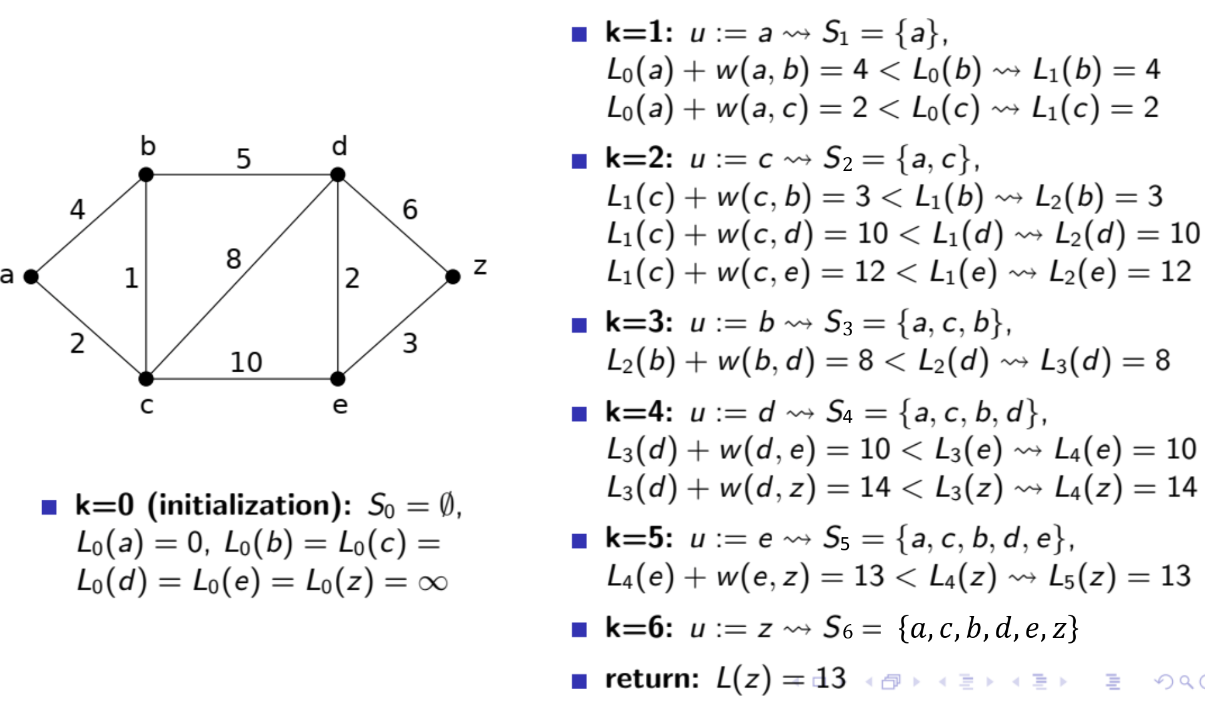
哈密顿回路存在充分条件: Ore’s Theorem: 点数大于 3 的简单图,如果 ∀ { u , v } ∉ E , deg ( u ) + deg ( v ) ≥ n \forall\{u,v\}\notin E,\deg(u)+\deg(v)\ge n ∀ { u , v } ∈ / E , deg ( u ) + deg ( v ) ≥ n deg ( u ) ≥ n 2 \deg(u)\ge \frac{n}{2} deg ( u ) ≥ 2 n
Djikstra’s Algorithm:
Planar Graph 平面图:可以被画在平面上且没有边相交
Jordan Curve Theorem:简单闭合平面曲线把平面分为内外区域,连接这两个区域的曲线一定和该曲线相交;图 K 3 , 3 K_{3,3} K 3 , 3
Regions 面:平面图划分出来的多个区域,有 exterior 外部面,boundary,degree(一个面的边界上边的数量)
Euler’s Formula:对于连通简单平面图,面的数量 r = e − v + 2 r=e-v+2 r = e − v + 2 p p p r = e − v + p + 1 r=e-v+p+1 r = e − v + p + 1
一个平面连通简单图,如果每个面的度都大于 l l l ∣ E ( G ) ∣ ≤ l l − 2 ( ∣ V ( G ) ∣ − 2 ) |E(G)|\le \frac{l}{l-2}(|V(G)|-2) ∣ E ( G ) ∣ ≤ l − 2 l ( ∣ V ( G ) ∣ − 2 )
Homeomorphic 同胚的:同一个图经过不同的 elementary subdivision 初等细分(拆分一条边为两条)后获得的图
Kuratowski’s Theorem:一个图是非平面的当且仅当其有一个子图和 K 3 , 3 K_{3,3} K 3 , 3 K 5 K_5 K 5
Dual Graph 对偶图:一个平面图,面变成点,点变成面后得到 G ∗ G^* G ∗ 2 v − 2 2v-2 2 v − 2 G ∗ ∗ = G , v ∗ = f , e ∗ = e , f ∗ = v G^{**}=G,v^*=f,e^*=e,f^*=v G ∗ ∗ = G , v ∗ = f , e ∗ = e , f ∗ = v f f f
chromatic number χ ( G ) \chi(G) χ ( G ) k k k k k k 1 ≤ χ ( G ) ≤ ∣ V ∣ 1\le \chi(G)\le |V| 1 ≤ χ ( G ) ≤ ∣ V ∣
χ ( G ) = 1 \chi(G) = 1 χ ( G ) = 1 E = ∅ E = \emptyset E = ∅ χ ( G ) = 2 \chi(G) = 2 χ ( G ) = 2 G G G ∣ E ∣ ≥ 1 |E| \ge 1 ∣ E ∣ ≥ 1 χ ( K n ) = n \chi(K_n) = n χ ( K n ) = n n ≥ 1 n \ge 1 n ≥ 1 χ ( G ) ≥ n \chi(G) \ge n χ ( G ) ≥ n G G G K n K_n K n χ ( C n ) = 2 \chi(C_n) = 2 χ ( C n ) = 2 2 ∣ n 2|n 2 ∣ n χ ( C n ) = 3 \chi(C_n) = 3 χ ( C n ) = 3 2 ∣ ( n − 1 ) 2|(n-1) 2 ∣ ( n − 1 ) n ≥ 3 n \ge 3 n ≥ 3 χ ( G ) ≤ Δ ( G ) + 1 \chi(G) \le \Delta(G) + 1 χ ( G ) ≤ Δ ( G ) + 1 Δ ( G ) = max { deg ( v ) : v ∈ V } \Delta(G) = \max\{\deg(v): v \in V\} Δ ( G ) = max { deg ( v ) : v ∈ V } 树的定义:无向无环图里两个点之间有唯一路径;n n n n − 1 n-1 n − 1 m m m n = m i + 1 n=mi+1 n = m i + 1
Preorder/Inorder/Postorder traversal; Prefix/Infix/Postfix notation
Spanning tree 生成树:一个简单图含有生成树当且仅当其连通
Prim’s Algorithm:选取一个点开始,选取与当前树连接的最小权边
Kruskal’s Algorithm:初始每个点自成一个 component,循环地选取最小权边并 merge 两个 components(除非成环)
Language: 可被自动机 M 1 M_1 M 1 A = L ( M 1 ) A=L(M_1) A = L ( M 1 )
有限自动机 M M M ( Q , Σ , δ , q 0 , F ) (Q,\Sigma,\delta,q_0,F) ( Q , Σ , δ , q 0 , F ) Q Q Q Σ \Sigma Σ δ \delta δ δ : Q × Σ → Q \delta:Q\times\Sigma\rightarrow Q δ : Q × Σ → Q δ ( q , a ) = r \delta(q,a)=r δ ( q , a ) = r q q q a a a r r r q 0 q_0 q 0 F F F
Union ∪ \cup ∪ A ∘ B = A B A\circ B=AB A ∘ B = A B A ∗ = { ϵ , a , b , a a , a b , b a , a a b , … } A^*=\{\epsilon,a,b,aa,ab,ba,aab,\dots\} A ∗ = { ϵ , a , b , a a , a b , b a , a a b , … }
Regular Expression:从字符集、空集和 ϵ \epsilon ϵ
正则语言的封闭性质:两个正则语言 A 1 ∪ A 2 A_1\cup A_2 A 1 ∪ A 2 Q = Q 1 × Q 2 , q 0 = ( q 1 , q 2 ) , δ ( ( q , r ) , a ) = ( δ 1 ( q , a ) , δ 2 ( r , a ) ) Q=Q_1\times Q_2, q_0=(q_1,q_2),\delta((q,r),a)=(\delta_1(q,a),\delta_2(r,a)) Q = Q 1 × Q 2 , q 0 = ( q 1 , q 2 ) , δ ( ( q , r ) , a ) = ( δ 1 ( q , a ) , δ 2 ( r , a ) ) F = ( F 1 × Q 2 ) ∪ ( Q 1 × F 2 ) F=(F_1\times Q_2)\cup(Q_1\times F_2) F = ( F 1 × Q 2 ) ∪ ( Q 1 × F 2 ) ϵ \epsilon ϵ
两个正则语言 A 1 ∘ A 2 A_1\circ A_2 A 1 ∘ A 2 ϵ \epsilon ϵ
Nondeterministic Finite Automata:允许接受 ϵ \epsilon ϵ δ \delta δ
NFA M M M M ′ M' M ′ Q ′ = P ( Q ) , q 0 ′ = { q 0 } , F ′ = { R ∈ Q ′ ∣ R intersects F } Q'=\mathbf{P}(Q),q'_0=\{q_0\},F'=\{R\in Q'|R \text{ intersects } F\} Q ′ = P ( Q ) , q 0 ′ = { q 0 } , F ′ = { R ∈ Q ′ ∣ R intersects F }
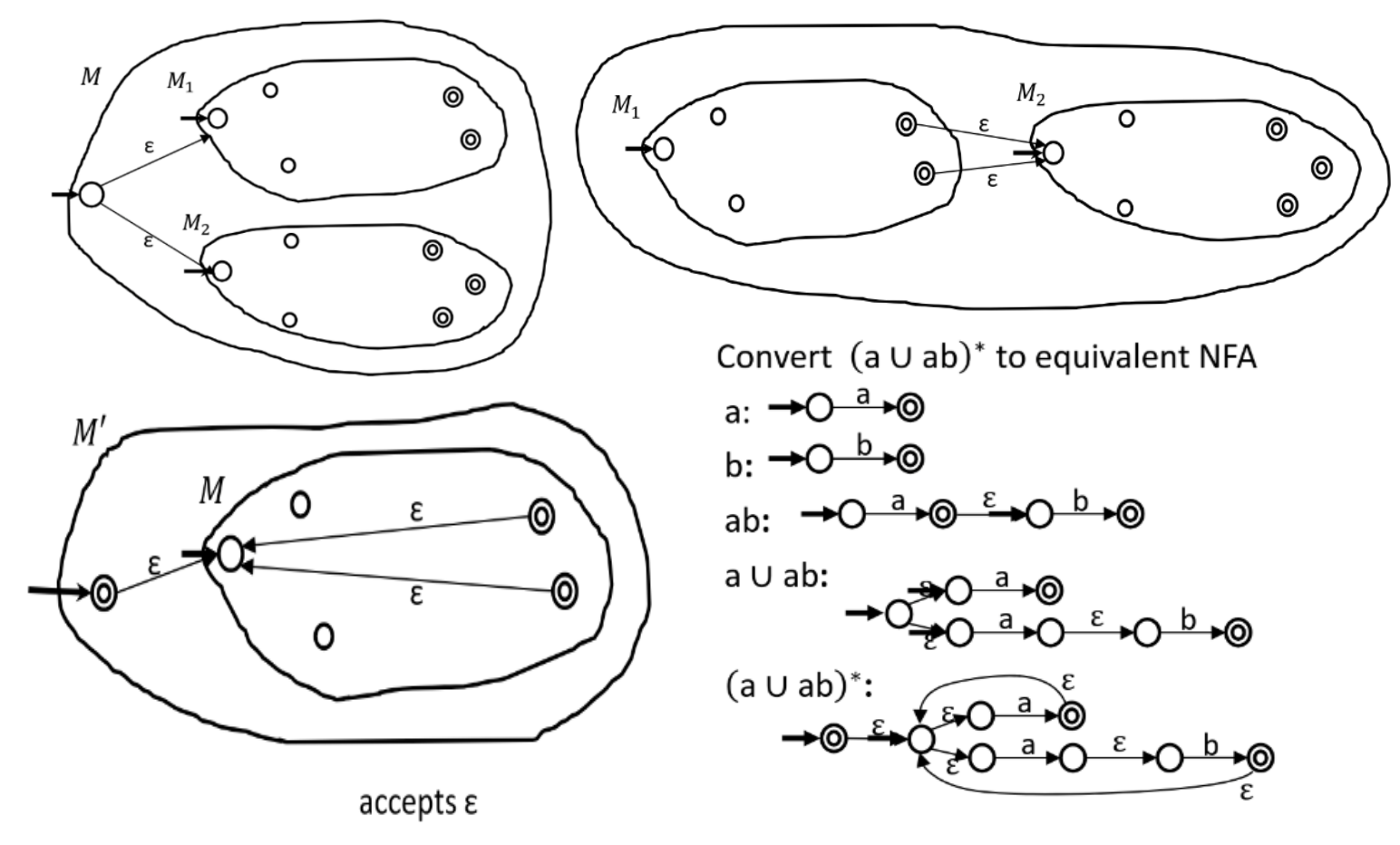
A 1 ∪ A 2 , A 1 A 2 , A ∗ A_1\cup A_2,A_1A_2,A^* A 1 ∪ A 2 , A 1 A 2 , A ∗
Generalized NFA:状态之间转换从字符变成正则表达式;每个 GNFA 都有等价的正则表达式(对状态数 k k k 2 2 2 k k k k − 1 k-1 k − 1
Context Free Grammars:四元组 ( V , Σ , R , S ) (V,\Sigma,R,S) ( V , Σ , R , S ) V V V Σ \Sigma Σ R R R V → ( V ∪ Σ ) ∗ V\rightarrow (V\cup\Sigma)^* V → ( V ∪ Σ ) ∗ S S S
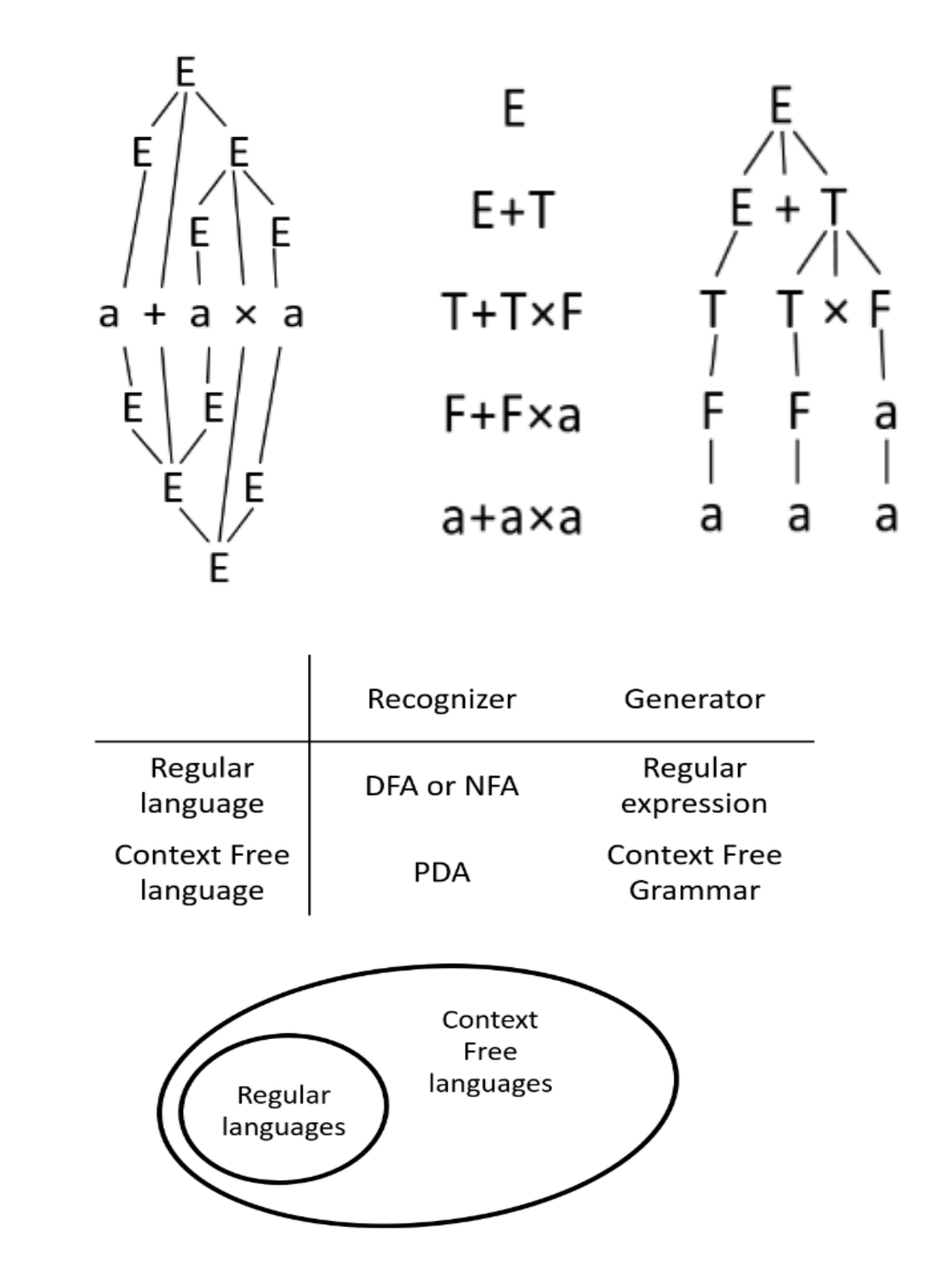
u , v ∈ ( V ∪ Σ ) ∗ u,v\in (V\cup \Sigma)^* u , v ∈ ( V ∪ Σ ) ∗ u u u v v v u ⇒ v u\Rightarrow v u ⇒ v u ⇒ ∗ v u \overset{*}{\Rightarrow}v u ⇒ ∗ v A = L ( G ) A=L(G) A = L ( G ) 例子:G 2 G_2 G 2 E → E + T ∣ T , T → T × F ∣ F , F → ( E ) ∣ a E\rightarrow E+T|T,T\rightarrow T\times F|F,F\rightarrow(E)|a E → E + T ∣ T , T → T × F ∣ F , F → ( E ) ∣ a G 3 G_3 G 3 E → E + E ∣ E × E ∣ ( E ) ∣ a E\rightarrow E+E|E\times E|(E)|a E → E + E ∣ E × E ∣ ( E ) ∣ a
虽然 L ( G 2 ) = L ( G 3 ) L(G_2)=L(G_3) L ( G 2 ) = L ( G 3 ) G 2 G_2 G 2 G 3 G_3 G 3
Pushdown Automata:外接一个栈,如识别 D = { 0 k 1 k ∣ k ≥ 0 } , B = { w w R ∣ w ∈ { 0 , 1 } ∗ } D=\{0^k1^k|k\ge0\},B=\{ww^R|w\in\{0,1\}^*\} D = { 0 k 1 k ∣ k ≥ 0 } , B = { w w R ∣ w ∈ { 0 , 1 } ∗ } ( Q , Σ , Γ , δ , q 0 , F ) (Q,\Sigma,\Gamma,\delta,q_0,F) ( Q , Σ , Γ , δ , q 0 , F ) Σ , Γ \Sigma,\Gamma Σ , Γ δ : Q × Σ ϵ × Γ ϵ → P ( Q × Γ ϵ ) \delta:Q\times\Sigma_\epsilon\times\Gamma_\epsilon\rightarrow\mathcal{P}(Q\times\Gamma_\epsilon) δ : Q × Σ ϵ × Γ ϵ → P ( Q × Γ ϵ ) δ ( q , a , c ) = { ( r 1 , d ) , ( r 2 , e ) } \delta(q,a,c)=\{(r_1,d),(r_2,e)\} δ ( q , a , c ) = { ( r 1 , d ) , ( r 2 , e ) }
CFG 转为 PDA:Push the start symbol on the stack, If the top of stack is Variable: replace with right hand side of rule (nondet choice). Terminal: pop it and match with next input symbol. If the stack is empty, accept.